
Vietnam Laos and Cambodia
US$50 billion proposed investment program over ten years

Prepared for prospective government partners, development finance institutions, institutional investors, philanthropic funders and participating communities.
9 October 2026
Proposal purpose
We propose a MicrobeBio Fund sponsored investment program to improve the reliability of food supplies, raise rural incomes and create jobs across Vietnam, Laos and Cambodia. The program connects agricultural production with water infrastructure, processing, storage, transport, nutrition and regional cooperation.
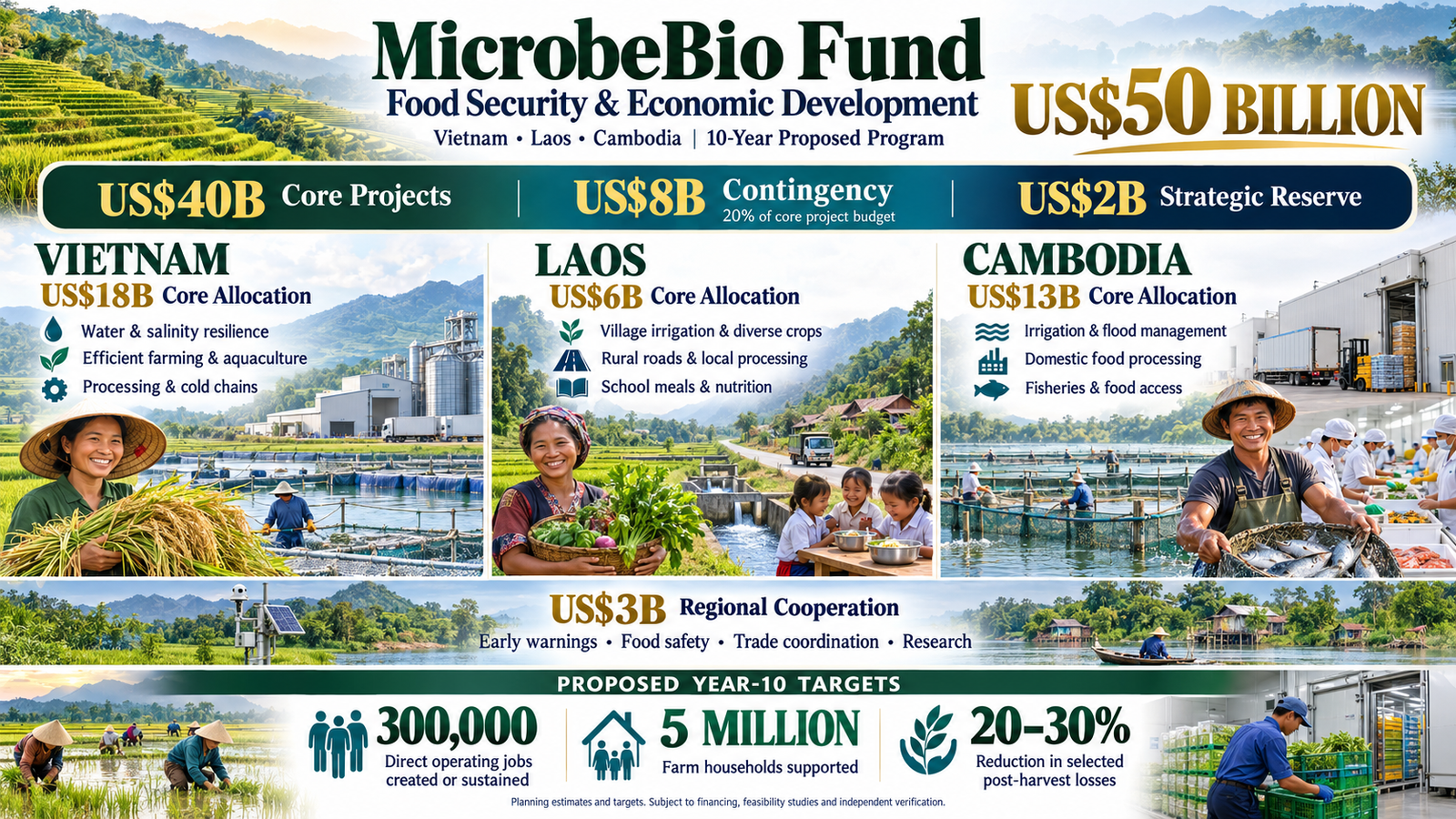
The proposed US$50 billion envelope comprises US$40 billion in planned projects, US$8 billion in contingency equal to 20 percent of the project budget, and a US$2 billion strategic reserve. Capital would be mobilized and deployed in phases, with investment tied to project readiness and independently verified performance.
This document is a development and capital mobilization proposal. It does not represent committed funding, an established licensed fund, government approval or an investment offering. The legal structure, fund manager, financing terms and project costs remain to be established through diligence.
Decision requested
Authorize project preparation and negotiations toward a ten year partnership; seek an initial US$500 million preparation and demonstration package within the first phase; establish independent governance before making material investment commitments.
Executive proposal
The MicrobeBio Fund would support productive rural economies in which farmers can grow dependable harvests, sell into functioning markets and retain a larger share of the value created. Families would benefit through more stable incomes, lower food losses, better access to diverse foods and stronger protection during climate or market shocks.
We propose country programs tailored to local conditions. Vietnam would emphasize agricultural competitiveness, Mekong Delta resilience and higher value processing. Laos would emphasize village water systems, nutrition, safe land access and affordable market connections. Cambodia would emphasize irrigation rehabilitation, domestic processing, storage and fisheries protection.
Program element | Proposed allocation |
Vietnam core projects | US$18.00 billion |
Laos core projects | US$6.00 billion |
Cambodia core projects | US$13.00 billion |
Shared regional programs | US$3.00 billion |
Contingency | US$8.00 billion |
Strategic reserve | US$2.00 billion |
Total program ceiling | US$50.00 billion |
The program would combine grants, concessional loans, private investment and cooperative or enterprise contributions. Public goods and nutrition programs would receive public or grant funding; processing and logistics enterprises would use commercial capital where revenues support it. Laos would receive financing adapted to its debt and implementation constraints.
Proposed development ambition
By year ten, aim to support 5 million participating farm households, establish or upgrade approximately 200 processing and logistics hubs, and create or sustain 300,000 direct full time equivalent operating positions. These are design targets, subject to feasibility work. New jobs, sustained jobs and improved livelihoods will be reported separately.
Food security targets would focus on household access, diet quality and shock resilience. The fund would seek a 20 percent relative reduction in measured food insecurity among evaluated target households, a 20–30 percent reduction in selected value chain losses, and a 15–25 percent improvement in real net farm income. Baselines and comparison groups would be established before scaling.
Development needs and investment rationale
Vietnam
Vietnam needs to protect a productive agricultural economy while increasing farmer margins and value added. The World Bank’s December 2025 Mekong Delta assessment identifies climate adaptation, productivity and movement up the value chain as priorities. Our proposed response links water management and suitable farming practices to processing, quality assurance and market access. [1]
Laos
Laos needs investments that improve rural household resilience without adding unaffordable public obligations. The World Bank’s June 2026 Economic Monitor describes fragile economic gains and substantial debt service pressures. This supports a financing approach that gives priority to grants, highly concessional funding and projects with manageable operating requirements. [2]
The Government and WFP’s 2025 food security and vulnerability assessment, published in 2026, provides a current basis for targeting nutrition and household support. District selection should use that evidence alongside local consultations rather than assume that all rural households have identical needs. [3]
Cambodia
Cambodia needs reliable water, better market access and stronger links between agricultural production and domestic enterprise. The World Bank’s water security investment supports rehabilitation of household and irrigation systems and water user management. The proposed fund would build on compatible existing work and avoid paying twice for already funded assets. [4]
Shared food security needs
The Mekong River Commission identifies rice, fish and other aquatic animals as central to regional diets and livelihoods. Fisheries, floodplain habitats and water use must therefore be evaluated together. Infrastructure that increases crop output but reduces fisheries can shift rather than solve a food security problem. [5]
Our investment rationale is that food availability, household purchasing power, nutrition and dependable supply chains must improve together. Storage without buyers, irrigation without maintenance, or farm inputs without field evidence are incomplete investments. Each funded cluster will identify the constraint, its proposed solution, the operator and the beneficiaries.
Program design and the role of MicrobeBio
Production to market clusters
Each cluster would connect participating farmers with dependable water, extension, aggregation, storage, processing where justified and identified buyers. Projects would be selected around existing production areas and market demand. New land expansion would require land rights, environmental and water assessments; it would not be the default growth strategy.
Agricultural biotechnology
MicrobeBio would propose expertise in biological crop inputs, soil management, biological crop protection, aquaculture water management and organic waste treatment. Potential interventions include microbial inputs, integrated pest management and recycling organic residues into safe, usable materials. Local regulatory approval, product quality testing and independent field trials would precede commercial rollout.
Biological inputs would complement balanced nutrition, good seed, water management and appropriate pest control. The proposal assumes no universal yield improvement and no automatic replacement of fertilizers or other controls. Trials must measure net farmer profit as well as yield, soil indicators and input use.
Technology and production platforms
The program may support controlled environment agriculture for crops with demonstrated demand and favorable energy economics; precision nutrition based on soil and crop testing; root zone management; aquaculture systems; livestock health and approved probiotics; environmental treatment; and mushroom enterprises. These activities cover MicrobeBio’s proposed biotechnology platforms, but each must compete for funding on local merit.
Quality and supplier independence
Any MicrobeBio product supply, licensing or technical service contract would be separately disclosed and independently reviewed. The fund would use competitive procurement or document a justified exception. Independent directors would approve related party transactions; interested directors and staff would recuse themselves. Fund beneficiaries would not be required to purchase a sponsor product as a condition of participation.
Farmer participation
Participation would be voluntary. Cooperatives and farmer groups would receive practical training in bookkeeping, quality standards and contract negotiation. Agreements would state price formulas, payment dates, delivery requirements and accessible dispute procedures. Smallholders would retain lawful land rights and receive understandable information about financial obligations.
Vietnam investment program
Investment component | US$ billion |
Water storage drainage irrigation and salinity resilience | 5.50 |
Farm productivity and soil management | 2.00 |
Processing and agricultural enterprise | 3.50 |
Rural logistics storage and cold chains | 3.00 |
Aquaculture and livestock health | 1.50 |
Nutrition and targeted food access | 0.50 |
Watershed and environmental restoration | 1.00 |
Research skills and delivery capacity | 0.50 |
Vietnam core total | 18.00 |
Water projects would prioritize rehabilitation, salinity information, locally appropriate freshwater storage and drainage. Basin studies would determine whether proposed assets worsen flooding, disrupt fisheries or increase groundwater stress. Crop transitions would follow water conditions, farmer choice and buyer demand.
Farm programs would support high quality seed, soil testing, efficient water management, balanced nutrition, equipment services and cooperative marketing. Rice investments would align with Vietnam’s existing one million hectare high quality low carbon rice program rather than establish a competing national delivery system. [6]
Processing hubs would include suitable mills, dryers, fruit processing and seafood facilities with food safety systems. Facilities would be located only after confirming raw material supply, transport access, energy costs, buyers and expected utilization. Cold storage would include dependable power and funded maintenance.
Aquaculture investments would support hatchery quality, disease surveillance, water quality, effluent treatment and traceability. Environmental restoration would protect relevant watersheds and coastal habitats. Extension and laboratory capacity would connect research with farm decisions.
Proposed country design targets are 2.5 million farm households supported and 150,000 direct operating positions created or sustained by year ten. These are preliminary shares of the program ambition, not forecasts. Suitable locations would be selected with national and provincial authorities after screening existing project pipelines.
Laos investment program
Investment component | US$ billion |
Village irrigation and water security | 1.50 |
Diversified farming and soil management | 0.75 |
Local processing and enterprise | 0.60 |
Rural roads collection storage and logistics | 1.20 |
Livestock health and suitable aquaculture | 0.30 |
School meals nutrition and food access | 0.60 |
Safe land access watersheds and restoration | 0.60 |
Research skills and delivery capacity | 0.45 |
Laos core total | 6.00 |
The Laos program would emphasize repair of usable assets and services within reach of smallholder communities. Village irrigation, suitable solar pumping and small storage systems would be paired with water availability assessment, trained operators and an affordable maintenance plan.
Diversified production would combine locally appropriate staples with vegetables, legumes, fruit, poultry and fish where suitable. Nutrition programs would use local procurement when it can meet food safety, reliability and value requirements. Maternal and child support would be coordinated with competent public health institutions.
Road and collection investments would connect productive areas to practical market routes. Processing facilities for coffee, rice, fruit and other crops would be sized to realistic supply and demand. The fund would avoid using projected export sales to justify facilities without credible purchase agreements.
Unexploded ordnance risk assessments and accredited clearance, where necessary, would precede affected land and construction work. Community land arrangements, watershed protection and erosion control would be integrated into project preparation.
Proposed country design targets are 0.75 million farm households supported and 45,000 direct operating positions created or sustained. Project disbursement would reflect local delivery capacity. Sovereign borrowing would be considered only following an independent affordability assessment; grants and highly concessional finance would be prioritized for public goods.
Cambodia investment program
Investment component | US$ billion |
Irrigation drainage and flood management | 4.00 |
Farm diversification and soil management | 1.75 |
Domestic processing and agricultural enterprise | 2.40 |
Rural roads storage and cold chains | 1.80 |
Fisheries aquaculture and livestock health | 1.20 |
School meals nutrition and food access | 1.00 |
Watershed habitat and environmental restoration | 0.40 |
Research skills and delivery capacity | 0.45 |
Cambodia core total | 13.00 |
Irrigation projects would rehabilitate priority systems, improve drainage and water monitoring, and strengthen accountable water user organizations. Suitable higher value crops would be introduced only with dependable water and markets, while maintaining local staple food availability.
Processing investments would assess rice, cashew, fruit and suitable cassava value chains. Feasibility work would address electricity, wastewater, food safety, working capital, raw material seasonality and buyer specifications. Smaller modular facilities would be preferred where supply does not support larger plants.
Rural logistics would include grain drying, storage, refrigerated collection and priority road repairs. Warehouse finance would require enforceable title, insurance, quality control and independent stock verification.
Tonle Sap and Mekong fisheries projects would protect spawning habitats, support community management and improve landing site hygiene and cold storage. Aquaculture would complement habitat conservation; it would not be used as a blanket justification for reducing capture fisheries. Fisheries authorities and communities would participate in design.
Proposed country design targets are 1.75 million farm households supported and 90,000 direct operating positions created or sustained. Local procurement and vocational training would help rural workers enter processing, equipment maintenance, quality control and logistics jobs.
Regional cooperation program
Shared regional component | US$ billion |
Water climate and agricultural early warning systems | 0.70 |
Food safety laboratory and disease surveillance cooperation | 0.55 |
Trade facilitation and interoperable logistics information | 0.40 |
Emergency food coordination and reserve systems | 0.40 |
Independent research trials and technology validation | 0.40 |
Fund governance safeguards audit and evaluation | 0.35 |
Enterprise preparation and cross border skills programs | 0.20 |
Regional core total | 3.00 |
The fund would seek cooperation with existing regional institutions, including the Mekong River Commission where mandates overlap. Partnerships are proposed and would require agreement. National authorities retain responsibility for water operations, public health, food standards and emergency action.
Early warning systems would combine hydrological, weather, crop and market information with practical district response protocols. Data exchange agreements would define ownership, privacy, access and maintenance. Alerts would be useful only if agencies and communities can act on them.
Food safety and disease programs would support laboratory quality, interoperable reporting and trained personnel. Trade facilitation would focus on documentation, inspection coordination and predictable procedures. Physical country infrastructure remains in the national budgets.
Emergency food systems would strengthen national arrangements and coordination across borders. Reserve volumes and locations would follow demand, carrying costs and rotation plans. Transparent procurement and stock verification would protect public funds. Reserves would not be treated as a mechanism to guarantee commercial prices.
Regional research would run independently designed trials and publish results, including unsuccessful outcomes. Program governance and evaluation expenses would be capped within approved annual budgets and disclosed. The regional program has a proposed design target of 15,000 direct operating positions created or sustained, including participating cross border enterprises.
Budget financing and capital discipline
All amounts are preliminary US dollar planning allocations. Project budgets will be priced in relevant currencies and updated during appraisal. The total ceiling includes contingency and reserve; these amounts are not additional to US$50 billion.
Budget layer | US$ billion | Purpose |
Core projects | 40.00 | Country programs and shared regional activities |
Contingency | 8.00 | 20 percent of core costs for substantiated price and scope risks |
Strategic reserve | 2.00 | Approved opportunities emergencies or reallocation |
Total ceiling | 50.00 | Ten year program |
The US$8 billion contingency is notionally distributed as US$3.60 billion for Vietnam, US$1.20 billion for Laos, US$2.60 billion for Cambodia and US$0.60 billion for regional activities. Including those provisions, envelopes are US$21.60 billion, US$7.20 billion, US$15.60 billion and US$3.60 billion respectively. The US$2 billion strategic reserve remains unallocated.
Proposed financing source | Share | US$ billion |
Public budgets and concessional finance | 40% | 20.00 |
Private investment and commercial project finance | 35% | 17.50 |
Grants and climate related finance | 20% | 10.00 |
Participating enterprises and cooperatives | 5% | 2.50 |
Total sources target | 100% | 50.00 |
This is a consolidated program financing target. It includes partner capital and is not a claim that MicrobeBio has US$50 billion in cash. Co-financing will be counted only when legally committed, and the same dollar will not be counted as both fund capital and external investment. Borrowing is a funding source with repayment obligations, not free capital.
Contributions from households would be voluntary and affordable. Revenue projects would require financial models, buyer diligence and stress tests. Grants would fund public benefits that cannot support commercial returns. No fund wide investment return is forecast before the portfolio and terms are defined.
Job creation and rural enterprise
Employment is a central program objective. Jobs would arise in construction, irrigation services, processing, food safety, transport, equipment repair, nurseries, aquaculture, extension and local enterprise. Mechanization may displace some tasks, so training and transition support must accompany equipment investments.
Illustrative direct operating job model | Assumption | Positions |
Processing and logistics hubs | 200 hubs × 600 FTE | 120,000 |
Farm and technical service centers | 1,000 centers × 40 FTE | 40,000 |
Supported small and medium enterprises | 4,000 firms × 20 FTE | 80,000 |
Other water fisheries nutrition and program operators | Bottom up project validation required | 60,000 |
Proposed year ten operating target | Created or sustained positions | 300,000 |
This model is an illustrative design scenario, not an econometric forecast. Average hub staffing includes associated operations only where directly attributable and separately registered. Smaller or more automated facilities may employ substantially fewer workers. Every funded project must replace these assumptions with its own staffing plan.
For temporary works, an illustrative US$12 billion of labor intensive investment with a 25 percent labor share and US$3,000 annual equivalent labor cost would support approximately 1 million job years over ten years. That is about 100,000 average annual full time equivalents, not 1 million permanent jobs or necessarily 1 million distinct workers. These works overlap relevant core budget lines and are not an added allocation.
Indirect and induced employment will be assessed independently using country specific supply chain evidence. Such estimates will be reported separately and will not be added to direct headcounts without overlap checks. The 5 million farm household target measures livelihood support, not new employment.
Contracts would require lawful wages, safe work, grievance access and transparent hiring. Proposed inclusion objectives are at least 40 percent women among trainees and participating entrepreneurs, with youth apprenticeship routes and practical accommodations. These are program goals adapted to local circumstances, not claims of achieved participation.
Food security outcomes and measurement
The fund would address food availability, affordability, diet quality and resilience. Production investments improve supply; processing and storage reduce waste; jobs and farm incomes improve purchasing power; nutrition programs help people whose needs are not met by market income alone.
Indicator | Proposed year ten target | Verification |
Participating farm households | 5 million unique households | Deduplicated participant registry |
Real net farm income | 15–25% increase in evaluated cohorts | Costs revenue inflation and comparison analysis |
Selected post harvest losses | 20–30% relative reduction | Commodity specific physical loss sampling |
Household food insecurity | 20% relative reduction in evaluated target cohorts | Validated survey with baseline and comparison |
Nutrition and school meal reach | 2 million unique people over program period | Attendance delivery and recipient records |
Water service performance | Project specific reliability targets | Water balances service uptime and user surveys |
Targets are proposed and will be revised after baseline surveys and feasibility studies. A relative reduction is distinct from a percentage point change: if measured food insecurity is 30 percent at baseline, a 20 percent relative reduction means 24 percent. National outcomes cannot be attributed to this program without appropriate evidence.
Diet monitoring would assess diversity and access to nutritious foods, rather than only cereal tonnage. School meals would require food safety, reliable procurement and nutritionally appropriate menus. Child growth and clinical indicators would be measured only through qualified institutions and appropriate consent.
Quarterly implementation reports would cover spending, assets, procurement and service availability. Annual independent reviews would assess household and enterprise outcomes. Impact evaluations would use comparison groups or phased rollout designs where feasible; pre-existing funded projects would be separated from incremental fund effects.
The fund would publish annual country results, including failed projects, adoption shortfalls and adjustments. Data would be disaggregated by sex, age and relevant geography while protecting individual privacy. Outcome linked finance would pay against verified results rather than equipment delivery alone.
Implementation schedule and first phase
Phase | Years | Ceiling | Delivery priorities |
Preparation and initial delivery | 1–2 | US$8B | Diligence repairs trials nutrition and first clusters |
Expansion of proven projects | 3–5 | US$20B | Water processing storage roads and enterprise growth |
Completion and consolidation | 6–10 | US$20B | Scale successful clusters and secure operations |
Strategic reserve | Flexible | US$2B | Approved reallocation or response needs |
Total | US$50B | Includes contingency in phase ceilings |
The first three phases contain US$40 billion of core projects and US$8 billion of contingency. Indicative core spending is US$6.667 billion, US$16.667 billion and US$16.666 billion; corresponding contingency is US$1.333 billion, US$3.333 billion and US$3.334 billion. Timing is governed by readiness rather than a requirement to spend all funds by a date.
Initial US$500 million package within phase one
Use | US$ million |
Feasibility engineering baselines legal structuring and consultation | 100 |
Urgent irrigation storage and road rehabilitation | 150 |
Demonstration clusters and independently evaluated trials | 100 |
Local procurement nutrition and school meals | 75 |
Management systems safeguards and early warning readiness | 25 |
Package contingency | 50 |
Total initial package | 500 |
This package is contained within the phase one envelope; its US$50 million contingency draws from phase one contingency. It is a capital mobilization objective and does not authorize unfunded commitments.
During the first 90 days after effective establishment, appoint the preparation team, confirm government focal points, map existing investments and define project screening criteria. By month six, complete priority baselines and preliminary engineering. By month twelve, aim to close initial eligible projects with named operators and committed funding. By month twenty four, use independent results to decide which clusters merit expansion.
Governance procurement and project approval
The proposed architecture is a professionally managed umbrella program with country implementation arrangements and separate project entities where appropriate. Legal counsel will determine domicile, licensing, tax treatment and permissible investment instruments. National authorities retain statutory approvals; the fund board controls fund capital within its mandate.
Independent oversight
Establish a board with independent development, investment, agricultural and fiduciary expertise; an investment committee; an audit and risk committee; and country advisory groups with farmer and community representation. A qualified manager would administer capital, reporting and compliance. Annual external audits and published procurement records would support accountability.
Project approval conditions
Before financing, require a defined problem and baseline; feasibility and alternatives analysis; lawful land and water access; permits; environmental and social assessment; beneficiary consultation; credible cost estimates; committed financing; an operating and maintenance plan; and measurable outcomes. Revenue projects additionally require buyer diligence, financial stress testing and a workable repayment structure.
Disbursement would follow verified milestones, with independent certification for material civil works. Cost overruns require documented causes and committee approval. Reallocation between country envelopes would require board approval, affected government consultation and preservation of overall food security objectives.
Procurement and financial controls
Use open competitive procurement wherever practical. Publish awards, beneficial ownership disclosures and related party interests. Separate purchasing, payment approval and verification functions. Establish whistleblower access, sanctions for misconduct and mechanisms to recover improperly used funds.
Contingency and reserve release
Contingency may cover justified unforeseen project costs within approved scope; it cannot automatically finance weak project economics. The strategic reserve requires a separate board resolution supported by appraisal. Reserve commitments must stay within the US$50 billion ceiling and be reported publicly with their purpose and expected outcomes.
Environmental social and operating safeguards
Water investments will evaluate cumulative basin effects, downstream supply, sediment, fisheries and flood dynamics. Designs will consider rehabilitation, demand management and ecosystem based alternatives before new structures. Large hydropower development is outside the proposed program.
Land acquisition and resettlement require lawful procedures, fair compensation where applicable and livelihood restoration. Indigenous and other affected communities require culturally appropriate engagement, and consent where applicable standards require it. The program will avoid conversion of critical habitats and involuntary participation in agricultural contracts.
Food and biological products require appropriate registration, traceability and independent quality control. Microbial products will be checked for identity, contamination, viable counts, stability and suitability for intended use. Waste treatment facilities require validated pathogen and contaminant controls; materials cannot be marketed as safe fertilizer without meeting relevant standards.
Material risk | Required response |
Climate and water shocks | Scenario testing early warning diversified production and response plans |
Debt and currency exposure | Affordability review concessional funding and currency stress tests |
Weak markets or low facility use | Confirmed buyers supply analysis and modular construction |
Operating failure | Named operator maintenance reserve training and service contracts |
Land or community disputes | Early consultation rights verification and accessible grievance process |
Sponsor conflicts or misuse of funds | Independent review procurement disclosure and external audit |
Low technology performance | Controlled trials phased adoption and stop or redesign decisions |
Every asset must have a funded lifecycle plan. Public assets need a responsible agency or water user operator; commercial assets need maintenance reserves within business cash flows. User fees must be assessed for affordability. Initial operating support is budgeted within projects, but indefinite subsidies are not assumed.
Annual portfolio reviews would test lower yields, lower selling prices, higher input and energy costs, slower adoption and construction delays. Projects that fail agreed performance or safeguards requirements would receive corrective action, pause or exit decisions rather than automatic expansion.
Economic benefits and partnership request
Benefits to participating countries
The proposed investments can increase domestic value added by processing more food locally, improve the reliability of sales and reduce avoidable losses. Better water and logistics services can reduce income volatility. Training and enterprise finance can help rural workers access formal and skilled employment. Nutrition investments can protect learning and household wellbeing.
Fiscal and foreign exchange benefits would depend on profitable enterprises, tax rules and financing costs. The fund will not claim a GDP increase, export gain or return on investment without country models and project evidence. Economic appraisal will compare incremental benefits with capital, operating and environmental costs, avoiding double counting farm sales and processing output.
Responsibilities of proposed partners
Government partners would identify priorities, coordinate permits and agencies, provide suitable public co-financing and designate asset operators. Development institutions and donors would support public goods, preparation, concessional capital and independent evaluation. Private investors would finance suitable revenue projects and bring operating expertise. Cooperatives and communities would participate in design, governance and monitoring.
MicrobeBio would seek a sponsor and technical coordination role subject to verified capacity and transparent contractual arrangements. Qualified external operators, engineers, fund managers and research institutions would deliver areas outside that capacity. This proposal does not presume exclusive control by MicrobeBio over national agricultural programs.
Requested next decisions
We request expressions of interest to form the partnership, begin government consultations and mobilize the initial US$500 million package. Before capital solicitation or investment commitments, finalize legal structure, manager selection, independent governance and financing documentation. Country work plans should then identify the first projects, costs, buyers, operators and measurable benefits.
The US$50 billion ceiling provides a framework for coordinated investment over ten years. The immediate practical objective is a credible first portfolio that demonstrates improved food access, stronger farm incomes and durable jobs, and supplies the evidence needed for subsequent investment rounds.
Scope boundaries
The program includes food system infrastructure, agricultural enterprises, technical services, targeted nutrition and initial operating support. It excludes general national highway or port networks, major hydropower dams, unrelated industrial development and indefinite operating subsidies. Land, taxes, duties and utility connection costs must be included where applicable in individual appraisals.
Evidence and planning assumptions
The sources below support the development rationale. They do not validate the proposed US$50 billion budget, employment scenario or numerical outcome targets, which are planning assumptions prepared for this proposal. Sources were reviewed on 9 October 2026.
[1] World Bank. World Bank Report Charts a Sustainable Pathway for Viet Nam’s Mekong Delta. 17 December 2025.
https://www.worldbank.org/en/news/press-release/2025/12/17/world-bank-report-charts-a-sustainable-pathway-for-viet-nam-s-mekong-delta
[2] World Bank. Lao Economic Monitor June 2026 Key Findings. 2026.
https://www.worldbank.org/en/country/lao/publication/lao-economic-monitor-jun-2026-consolidating-reform-momentum-amid-volatility-key-findings
[3] World Food Programme. 2025 Comprehensive Food Security and Vulnerability Analysis in Lao PDR. 25 June 2026.
https://www.wfp.org/publications/2025-comprehensive-food-security-and-vulnerability-analysis-lao-pdr
[4] World Bank. World Bank Approves Major Investment in Water Security for Cambodia. 21 June 2024.
https://www.worldbank.org/en/news/press-release/2024/06/21/world-bank-approves-major-investment-in-water-security-for-cambodia
[5] Mekong River Commission. Fisheries. Accessed October 2026.
[6] World Bank. KWPF Grant Supports Low carbon Rice Farming in Viet Nam. 20 May 2025.
https://www.worldbank.org/en/news/feature/2025/05/20/kwpf-grant-supports-low-carbon-rice-farming-in-viet-nam
Assumptions to validate before approval
Confirm the ten year start date, implementing regions, unique beneficiary counts, available water, existing funded assets, labor costs, facility staffing, land access, technology performance, climate risks, operating costs and market demand. Prepare bottom up cost estimates and country financing plans. Separate investor return models from economic benefit analyses and social program outcomes.